FIELD & EVIDENCE REPORTING · 9 MIN READ
From Measurements, Notes and Photos to One Completed Inspection Report
Measurements, notes and photos are usually captured as parts of the same inspection. Reporting becomes inefficient when they are separated into different manual workflows and reconstructed later inside the final document.
For the underlying technical principles, W3C's PROV model defines how information can be linked to its sources and transformations, while Library of Congress image-format guidance covers image and metadata preservation. These sources describe the underlying concepts, not ACTUALin performance.
Published October 1, 2026 · ACTUALin Technical Resources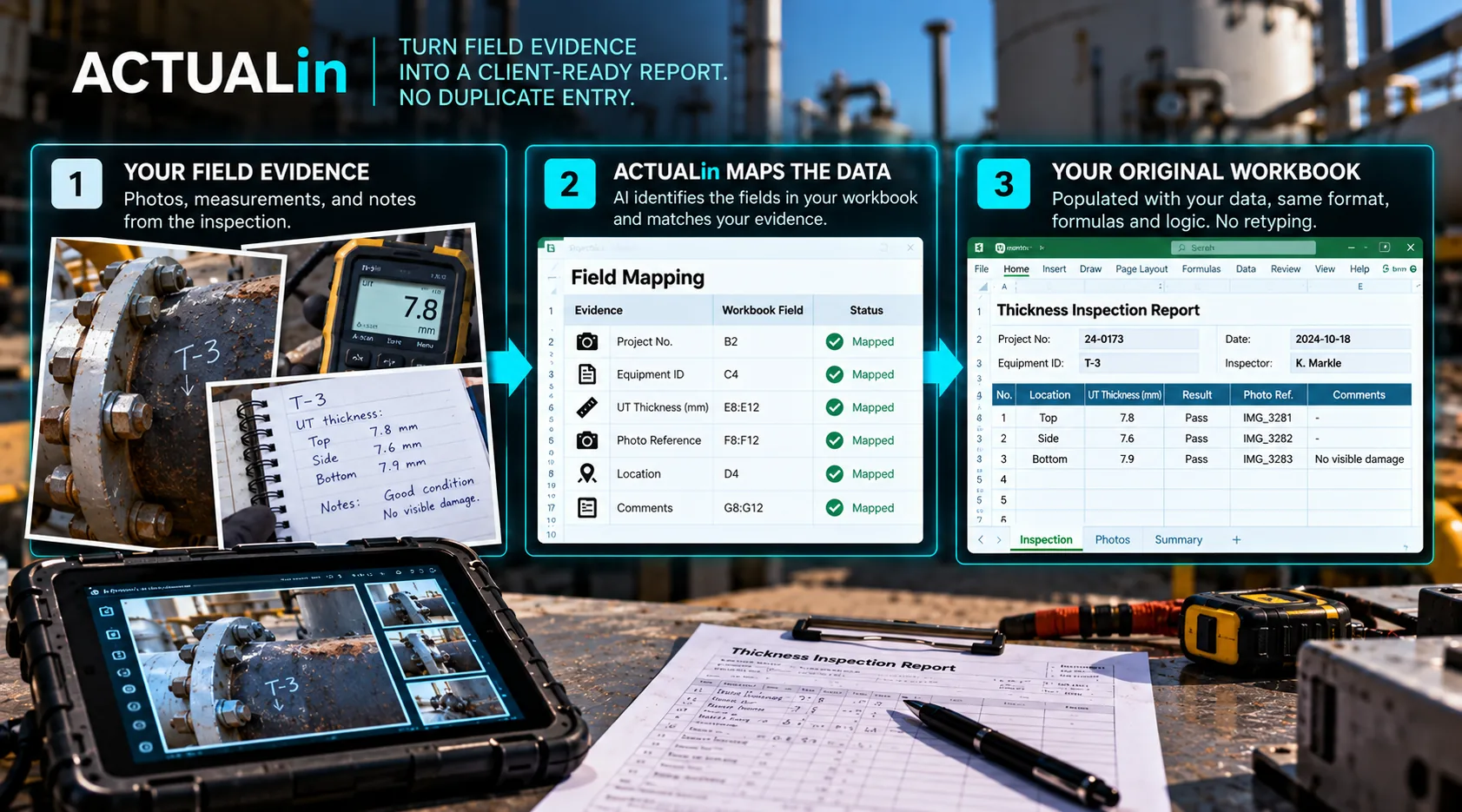
A measurement, a field note and a photograph may describe the same inspection finding, even when they arrive as three separate files. Moving all three into Excel is not enough. The report must preserve which equipment, location and observation connect them.
Consider an illustrative inspection of two similar components. A technician records a 4.2 mm reading for Component B, notes a visible surface condition and captures a close-up photograph. Those records form a useful group only if the observation and photograph really refer to the same identified component. The numerical reading alone does not establish the photograph's subject.
Three evidence types, one inspection point
The measurement contributes a recorded value and unit. It also needs a source identifier, method or location where applicable, so the correct report field can be selected.
The note describes what the technician observed and may contain qualifications that a structured field cannot express. Its meaning should not be strengthened during automated rewriting.
The photograph can provide visual support for the observation. It does not independently prove the component identity when the image shows an indistinguishable close-up.
Component B → recorded reading + original observation + associated photograph → reviewable evidence group
These are illustrative records, not a claim that ACTUALin measured or analyzed this particular inspection.
What happens when one link is missing?
Suppose the image file has only its camera filename and was copied into a folder without the original component association. The reading and note may still have reliable Component B identifiers, but it would be unsafe to conclude the photograph belongs to them solely because the files were captured close together.
The system can still propose the known measurement and observation mappings while leaving the photo association unresolved. Keeping one questionable image out of the report is not the same as discarding the rest of the evidence.
Supported reading and note → propose report entries. Unverified photo link → hold for review.
The W3C provenance primer provides a model for connecting information with its sources. The NIST metrological traceability guidance covers documented measurement relationships. These are technical references, not evidence of ACTUALin's performance on a particular workbook.
The report introduces a second set of relationships
The source evidence may be associated correctly while the Excel workbook presents several places that look suitable. Each component might have its own Reading and Comments fields, with photographs on a separate worksheet.
A proposed entry needs to identify both the source group and the exact destination. The reviewer should be able to confirm the intended component, field and sheet before anything is written. A blank region or similar label is not enough to prove the match.
Existing formulas, merged regions, drawings and authored content create an additional structural check. A correct evidence association does not authorize replacing a protected calculation or placing an image over a customer logo.
Review the evidence as a connected group
When the system presents a reading, note and photograph independently, a person may have to recreate the field context three times. A more useful proposal shows which items support the same inspection point and flags the specific relationships that remain uncertain.
A reviewer could approve the measurement destination, confirm the note's wording and leave the photo unassigned until its subject is established. The approved changes should then be executed conservatively, without asking the workbook writer to reinterpret the evidence.
For deeper treatment of photographs, see how inspection photos stay connected to their supporting observations. For the broader transfer process, see the field-to-client-report handoff.
Test the relationship, not just the file transfer
Use an actual report copy with repeated component sections and a mixed evidence set. Include a clearly identified measurement, a qualified observation, a correctly associated image and an image with insufficient location context. Verify that supported information reaches the right report section and that the ambiguous photograph remains unresolved.
Then check the generated workbook for formula preservation, existing images, layout and other untouched content. These are suggested acceptance tests, not claims of universal ACTUALin compatibility.
The completed report should let someone unfamiliar with the original fieldwork follow each supported entry back to the corresponding measurement, observation or photograph without guessing how the pieces were connected.