FIELD & INSPECTION REPORTING · 10 MIN READ
A Better Workflow From Field Inspection to Client Report
Improving inspection reporting does not have to mean replacing the field process or rebuilding the client's Excel report. The bigger opportunity is often the handoff between evidence captured in the field and the document delivered at the end.
For the underlying technical principles, NIST's metrological traceability guidance explains documented measurement relationships, while W3C's PROV model defines how information can be linked to its sources and transformations. These sources describe the underlying concepts, not ACTUALin performance.
Published October 1, 2026 · ACTUALin Technical Resources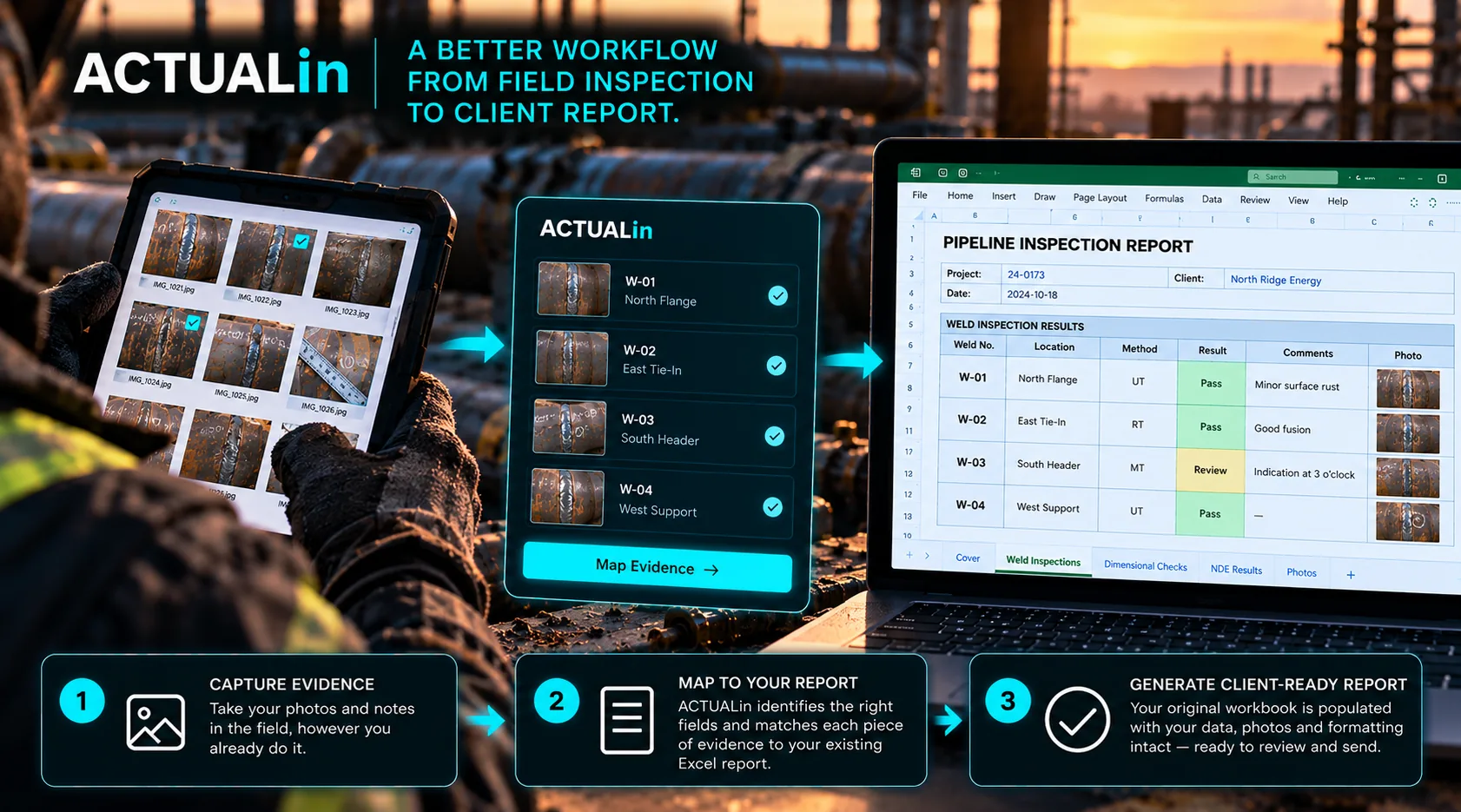
The handoff from field inspection to client report is where information often gets handled twice. A technician records measurements, observations and photographs during a job. Later, someone opens those records again to identify which Excel fields they belong to and reconstruct why each photograph was taken.
A better workflow makes the handoff explicit. It carries the evidence and its context forward, rather than asking the report writer to rediscover the inspection.
Follow one inspection from site to workbook
Consider an illustrative job involving two similar components. The technician records a reading, a short observation and a photograph for Component B. The customer's Excel report contains separate sections for Components A and B, with matching field labels.
The handoff succeeds only if the measurement, observation and image remain associated with Component B and the correct report section. Matching a value to the first cell called “Reading” would make the report look populated without establishing that it represents the inspected component.
Component B evidence → associated measurement, observation and photo → Component B report section
This is an example of a reporting handoff, not an ACTUALin customer case or a measured performance result.
What must survive the handoff?
The original evidence. Keep the recorded value, unit and observation available for checking. A summary should not replace the source if the reviewer may need to confirm its meaning.
Its subject. Component, location and inspection-point references connect otherwise similar readings and photographs to the correct part of the job.
The customer's destination. Existing reports may organize measurements by area, component or method. Sheet context, repeated sections, merges and formulas affect where a proposed entry belongs and whether the coordinate can be modified.
The unresolved items. If the source does not identify a component, the handoff should preserve that uncertainty instead of quietly assigning the reading to an available field.
As a general model for documenting relationships between inputs and outputs, the W3C provenance primer explains information origins and derivations. The Microsoft Open XML spreadsheet documentation describes the workbook structures the destination must respect. These are technical references, not independent validation of ACTUALin compatibility.
Change the handoff, not automatically the report
When the customer already requires a particular workbook, replacing it with a new form creates another problem. Its formulas, layout, headings, embedded images and print settings may be part of what the client expects to receive.
An assisted workflow can instead identify candidate destinations in that original workbook and present proposed changes for review. Confirmed entries can proceed to constrained generation. Ambiguous associations remain visible, and unsupported modifications should be withheld.
Capture evidence → preserve relationships → propose workbook changes → review → generate approved output
This describes a workflow goal and its safeguards. It does not imply every photo layout, workbook feature or uncertain evidence scenario is already supported automatically.
Two checks at different moments
Before generation: Does each proposed change follow from the recorded evidence, and does it refer to the correct customer report field? A human reviewer should be able to reject or resolve a questionable association while the original evidence is still visible.
After generation: Did the XLSX receive only the authorized changes? Check the populated cells, retained formulas, original images, merged regions and required print behavior against a baseline workbook.
These checks address different risks. Reviewing the proposed association does not guarantee the resulting file was written correctly, and confirming the XLSX opens does not establish that the association was justified.
How to tell whether the handoff improved
Measure the effort between completing fieldwork and delivering the client-ready report. Include time spent locating source notes, matching images to findings, re-entering values, correcting destinations and verifying the output. Test with an actual workbook, including repeated fields and at least one ambiguous source record.
If the report writer still has to reconstruct every relationship from scratch, the handoff has not materially changed, even if the final export runs quickly.
For a focused way to measure time savings, see how to evaluate reporting speed without weakening review. For the relationship between several evidence types, see keeping measurements, notes and photos together.
The practical goal is to preserve what the technician already established at the job site, then let the reporting process use it without silently adding facts or changing the customer's deliverable.