NDT REPORTING · 8 MIN READ
The Hidden Cost of Entering Inspection Data Twice
When a measurement, observation or job detail has already been recorded once, entering it again is not new data collection. It is a second handling step, and its cost extends beyond the seconds spent typing.
For the underlying technical principles, NIST's metrological traceability guidance explains documented measurement relationships, while W3C's PROV model defines how information can be linked to its sources and transformations. These sources describe the underlying concepts, not ACTUALin performance.
Published September 27, 2026 · ACTUALin Technical Resources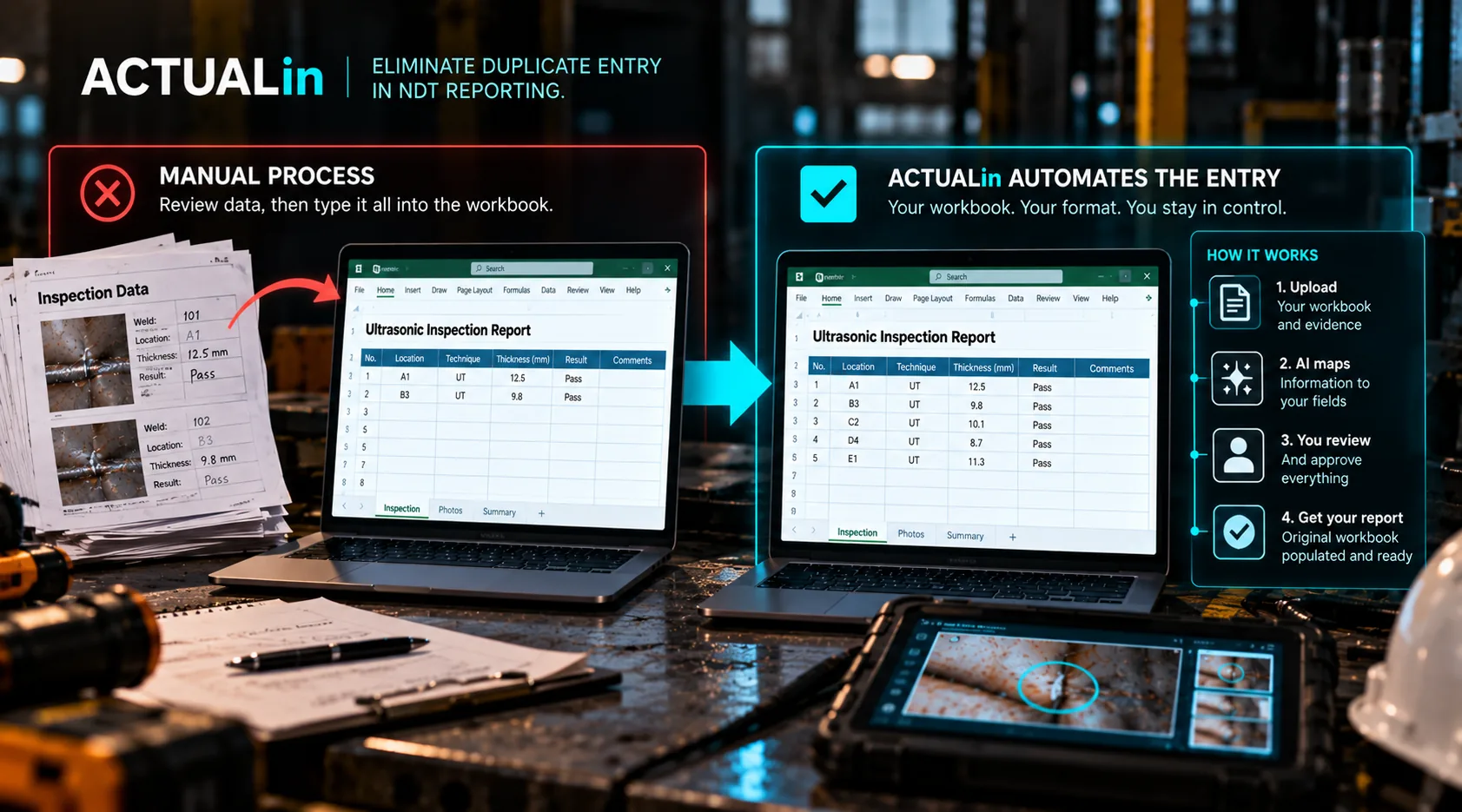
Duplicate inspection data entry costs more than the minutes spent typing. Technicians must relocate source evidence, restore its context, identify the correct report field and verify that the transfer was accurate. Each extra handoff creates opportunities for mistakes. Eliminating unnecessary repetition saves time while allowing technical checks to remain in place.
Inspection reporting often contains a quiet duplication that becomes normal over time.
A technician records a measurement in the field. Later, the measurement is entered into the final report. An observation is written in notes, then rewritten in a workbook. Job information is available in one place and copied into another. Photos are captured with context, then manually associated with that context again during reporting.
Each individual transfer looks small. Across every report, every technician and every working day, the repeated handling can become a meaningful part of the reporting workload.
What does duplicate inspection data entry really cost?
Duplicate entry costs more than typing time: it adds context switching, verification and opportunities for transcription errors. The visible action may be typing a value twice, but the second entry usually includes several hidden steps.
The technician has to locate the original evidence, recall or reconstruct its context, find the intended report location, enter the value, confirm that it was entered correctly and often check that surrounding workbook content was not disturbed.
Find evidence → reconstruct context → find report destination → re-enter → verify
Re-establishing the relationship between source evidence and report fields is the real unit of duplicate-entry work.
The first cost is technician time
The simplest cost is the time spent transferring information that already exists.
Rather than assuming a universal saving per report, measure it directly. Time a representative set of reports and separate technical interpretation from mechanical report assembly.
If a report contains 20 minutes of repeated transfer work and a team completes 100 similar reports in a month, that is roughly 33 hours spent on that step. If the measured transfer time is 5 minutes instead, the opportunity is much smaller. The point is to use the operation's real numbers.
Duplicate-entry hours = reports completed × duplicate-entry minutes per report ÷ 60
Once that number is known, labor cost can be estimated using the organization's own fully loaded hourly cost rather than an invented industry average.
The second cost is context switching
Report assembly rarely happens as one continuous typing exercise. The reporter moves between notes, photos, measurements, job information and the workbook.
Every transition requires a small amount of orientation: which component is this? Which area was being inspected? Which of these repeated report sections corresponds to the evidence?
That switching can make a short transcription task feel disproportionately slow because the technician is repeatedly rebuilding context rather than simply entering data.
The third cost is verification
Information that is transferred manually has to be checked manually.
A reviewer may need to confirm that a value was not transposed, that the correct repeated section was used, that the observation still means the same thing after being rewritten and that the photo supports the intended finding.
Some review is essential regardless of automation. But verification created solely because information was manually copied from one place to another is additional work generated by the workflow itself.
The fourth cost is another opportunity for error
Every manual transfer introduces a new point where accurate source evidence can become an inaccurate report entry.
The issue is not only obvious typing mistakes. A correct value can be associated with the wrong location. A note can lose context when shortened. A photo can be placed beside the wrong observation. A calculated cell can be overwritten instead of its intended input field.
A report can therefore contain correct evidence and still become incorrect during assembly.
The fifth cost is report turnaround
Duplicate entry happens after the field evidence already exists, which means it extends the time between completing the inspection and delivering the report.
A single report may only be delayed by a modest amount. Across a queue of reports, however, repeated assembly work competes for the same technician or reviewer time and can create backlog.
This is why report turnaround should be measured separately from fieldwork duration. The inspection can be complete while the deliverable is still waiting on document production.
The sixth cost is using technical people for clerical transfer
Technicians and reviewers should spend time where their judgment matters. Some reporting work genuinely requires that judgment: evaluating evidence, resolving ambiguity, reviewing conclusions and approving the final result.
Repeatedly moving an already-known job number, measurement or observation from one representation to another does not necessarily require the same level of expertise.
The objective is not to remove technical people from reporting. It is to concentrate their attention on the parts of reporting that actually need them.
Not every repeated entry should be automated
Two similar-looking entries can have different meanings. A field value may need interpretation before it belongs in a final report. A measurement may be valid but ambiguous about which component it describes. A conclusion may require professional judgment rather than simple transfer.
Automation should therefore distinguish between repeated handling and new technical decisions.
Where the relationship is clear, the system can propose the transfer. Where the relationship is uncertain, the uncertainty should remain visible for human review.
Measure duplicate entry with a simple report audit
Take several representative completed reports and reconstruct the reporting process. For each piece of information in the final workbook, ask where it first existed.
Mark information that was entered once directly into its final destination, information that was copied from another source, information that had to be interpreted before transfer and information that required technical judgment.
Then time the repeated-transfer category. Include searching and verification, not only keyboard time.
This creates a baseline that can be compared against any proposed reporting change.
Calculate the opportunity using your own operation
A practical model only needs a few inputs: reports per month, measured duplicate-entry minutes per report and the relevant labor cost.
Monthly duplicate-entry cost = reports × minutes per report ÷ 60 × hourly labor cost
For example, at 100 reports per month and a measured 20 minutes of duplicate entry per report, the workflow contains about 33 hours of duplicate-entry time each month. Multiply those hours by your own labor cost to estimate the direct monthly exposure.
This is not the same as guaranteed savings. Automation will still require review, exceptions and workflow overhead. The calculation identifies the size of the problem before deciding how much of it can realistically be removed.
The better target is the handoff
If evidence has already been captured, the next system should not require a person to manually recreate it simply because the final document is Excel.
A more direct workflow interprets the existing evidence against the existing workbook, proposes exact report changes, lets the user review them and writes only what was approved.
Field evidence → proposed report changes → human review → approved workbook
The final report still receives technical oversight. What changes is the amount of mechanical work required to get the known information there.
Duplicate entry is worth measuring because it is removable
Not every minute in inspection reporting is waste. Technical analysis, judgment and review are part of producing a trustworthy deliverable.
Duplicate entry is different. When the same information is already available with enough context to support the report, manually entering it again is a workflow cost that can be examined directly.
Measure it before redesigning the entire reporting system. You may find that the report itself is not the expensive part. The expensive part is making a person tell the report what the inspection already knows.