 ACTUALin
FIELD & INSPECTION REPORTING · 8 MIN READ
Why Inspection Reports Take So Long After the Fieldwork Is Finished
The inspection can be complete while the reporting work is only beginning. The delay often comes from reconstructing the fieldwork inside the final report, not from the inspection itself.
For the underlying technical principles, NIST's metrological traceability guidance explains documented measurement relationships, while W3C's PROV model defines how information can be linked to its sources and transformations. These sources describe the underlying concepts, not ACTUALin performance.
Published September 27, 2026 · ACTUALin Technical Resources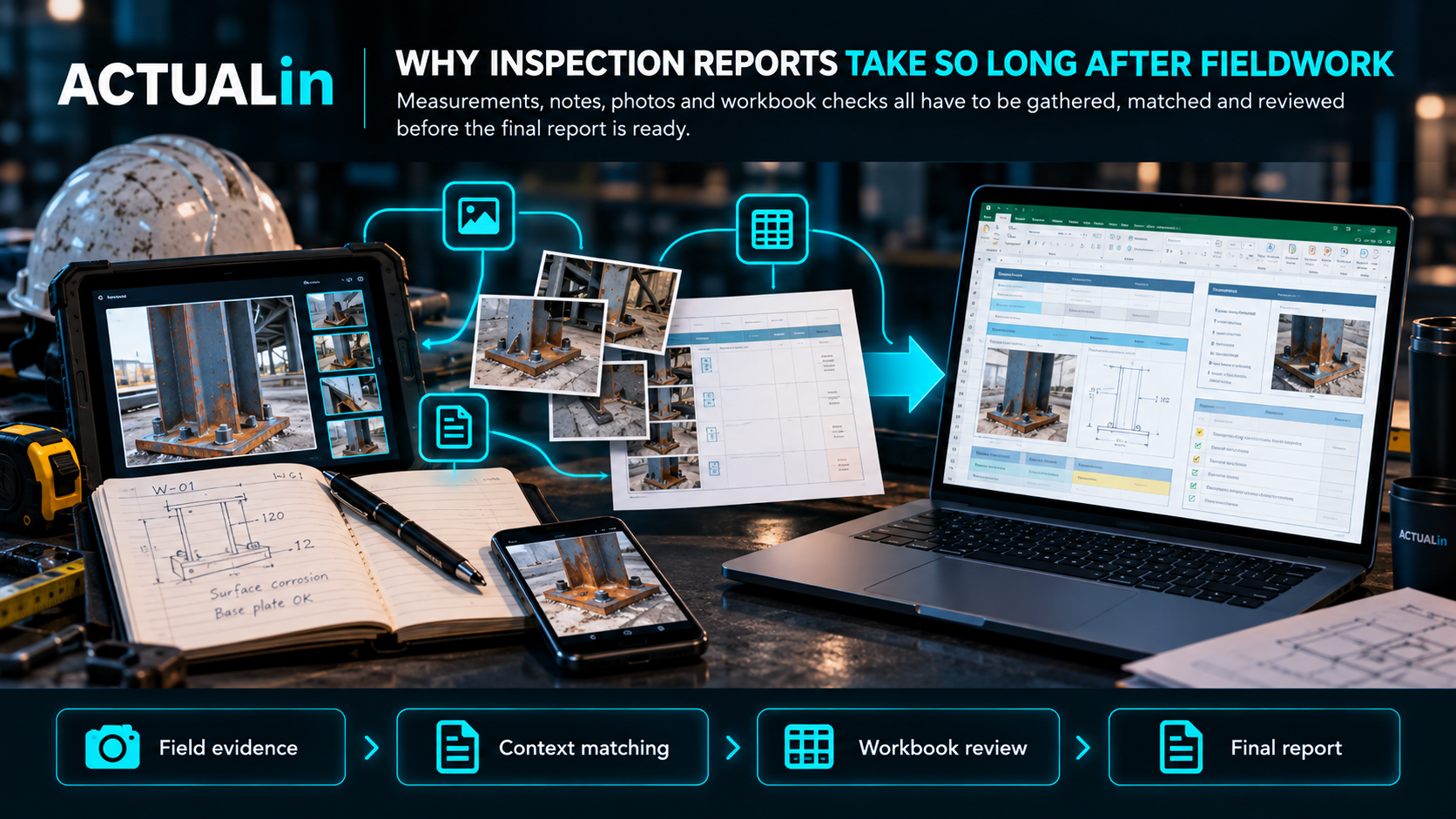
Inspection reports often take hours after fieldwork because measurements, notes, photographs and job details must be gathered, interpreted and entered again in the required document. Photo matching, repeated fields and checking the finished workbook add time. Reducing this reconstruction work can shorten turnaround without removing technical review.
The technician has finished the inspection. Measurements were taken. Conditions were observed. Photos were captured. The technical work in the field may be complete.
But the report is not.
What follows can be a second workflow: gather the evidence, reopen notes, identify which value belongs to which report section, transfer the information into Excel, find and place supporting photos, check formulas and formatting, then review the completed workbook.
The gap between completed fieldwork and delivery of the inspection report is where a large amount of reporting time can accumulate.
Why does an inspection report take time after fieldwork ends?
Reporting takes time after fieldwork because evidence must be reconstructed, matched to report sections and checked before delivery. Fieldwork produces evidence in context. A technician knows which component is being examined, where a measurement was taken and why a photo matters at the moment it is captured.
Later, report preparation has to reconstruct that context inside a document.
A number written in field notes must be associated with the correct location. An observation must reach the right repeated section. A photo must be connected to the condition it documents. The final report has to express the inspection clearly enough for someone who was not there.
Reconstructing the inspection evidence for a report is necessary. Reconstructing the evidence manually from scratch is not always necessary.
1. Evidence is scattered before reporting begins
Measurements, observations, job details and photos may not begin in one place. Even when each source is organized, report preparation can require moving between them repeatedly.
The technician is not simply entering values. They are searching, remembering and correlating information before each entry can be made.
That context switching is easy to overlook when estimating report time because no individual action appears particularly large.
2. The same information gets interpreted twice
A technician interprets what is happening during the inspection in order to record useful evidence. Later, the same evidence may have to be interpreted again to determine how it maps into the report.
Observe → record → finish inspection → reopen record → interpret again → enter into report
The second interpretation may be unavoidable when the original evidence lacks context. But when the context is already present, manually repeating the step creates unnecessary work.
3. Transcription is slow because placement matters
Copying a value takes seconds. Determining where that value belongs can take longer.
Technical workbooks may contain multiple sheets, repeated fields, merged areas and customer-specific sections. A label such as “Reading” or “Result” may appear several times.
The technician has to navigate the workbook and preserve the relationship between evidence and destination. That is why reporting time cannot be estimated simply by counting the number of values being typed.
4. Photos create their own reporting workflow
Photos are often captured quickly in the field and processed slowly afterward.
The reporter may need to identify the relevant images, determine which inspection item each supports, rename or organize them, resize them and place them in the appropriate report location.
If the connection between a photo and its observation is not preserved during capture, part of report preparation becomes detective work.
5. Existing Excel structure has to be respected
A finished report is not just a collection of values. Formulas may need to remain intact. Existing customer content should not be overwritten. Merged sections and formatting need to survive. Some cells may be calculated rather than intended for direct input.
That makes careful report preparation slower than indiscriminate data entry, and appropriately so. Speed is not useful if it damages the document or puts correct information in the wrong location.
6. Review catches more than technical conclusions
Final review often has to catch reporting mistakes in addition to reviewing the technical content.
Was a digit transposed? Did the correct observation reach the wrong component? Was a photo inserted beside the wrong finding? Was a formula replaced? Did a field remain blank because it was missed or because no evidence supported it?
The more manual assembly the report requires, the more the reviewer has to verify the assembly itself.
Which parts are good automation targets?
The strongest targets are repetitive steps where the required evidence already exists.
That includes interpreting field evidence against known report context, proposing likely destinations, carrying repeated job information into intended fields, keeping photos associated with supporting observations and writing approved information into the workbook.
Existing evidence + existing workbook → proposed report changes → human review → controlled generation
The objective is not to automate the technical decision simply because it occurs during reporting. It is to reduce the mechanical work surrounding decisions that have already been made.
What should stay under human control?
Technical judgment, ambiguous associations and final acceptance deserve explicit review.
If evidence could reasonably belong to more than one report location, automation should not hide that uncertainty. If a conclusion requires professional interpretation, the system should not turn a plausible inference into an approved result on its own.
A faster report is valuable only if the reviewer can still understand and control what entered it.
Move review before final generation
Traditional reporting often makes the completed workbook the review surface. By then, every mapping decision has already been made, usually through manual entry.
A proposed-change workflow moves those decisions into view first. The reviewer can see what information is being proposed, where it will go and whether the association is sufficiently supported.
Once approved, the workbook-writing step can become narrow and deterministic rather than another interpretation step.
Measure the time after the inspection
If report turnaround is a problem, measure the post-fieldwork workflow separately from the inspection itself.
Track how long it takes to gather evidence, transfer notes and measurements, place photos, navigate the workbook, correct transcription errors and complete final review. Those categories reveal whether the delay is technical analysis or document assembly.
They also make automation easier to evaluate. Saving time on the actual bottleneck matters more than adding features to a stage that was already efficient.
The inspection being finished should mean more
A completed inspection already contains most of the information needed for its report. The reporting workflow should preserve and reuse that work rather than require the technician to recreate it inside another document.
The final Excel workbook may still need review, judgment and approval. But the path from field evidence to that workbook can be much shorter when the evidence does not have to be manually reassembled one field at a time.