 ACTUALin
PHOTO & EVIDENCE REPORTING · 8 MIN READ
Why Inspection Photos Should Stay Connected to the Evidence They Support
An inspection photo becomes more useful when the report preserves what it shows, where it came from and which observation it supports. Lose those relationships and the image becomes something somebody has to interpret again later.
For the underlying technical principles, W3C's PROV model defines how information can be linked to its sources and transformations, while Library of Congress image-format guidance covers image and metadata preservation. These sources describe the underlying concepts, not ACTUALin performance.
Published September 30, 2026 · ACTUALin Technical Resources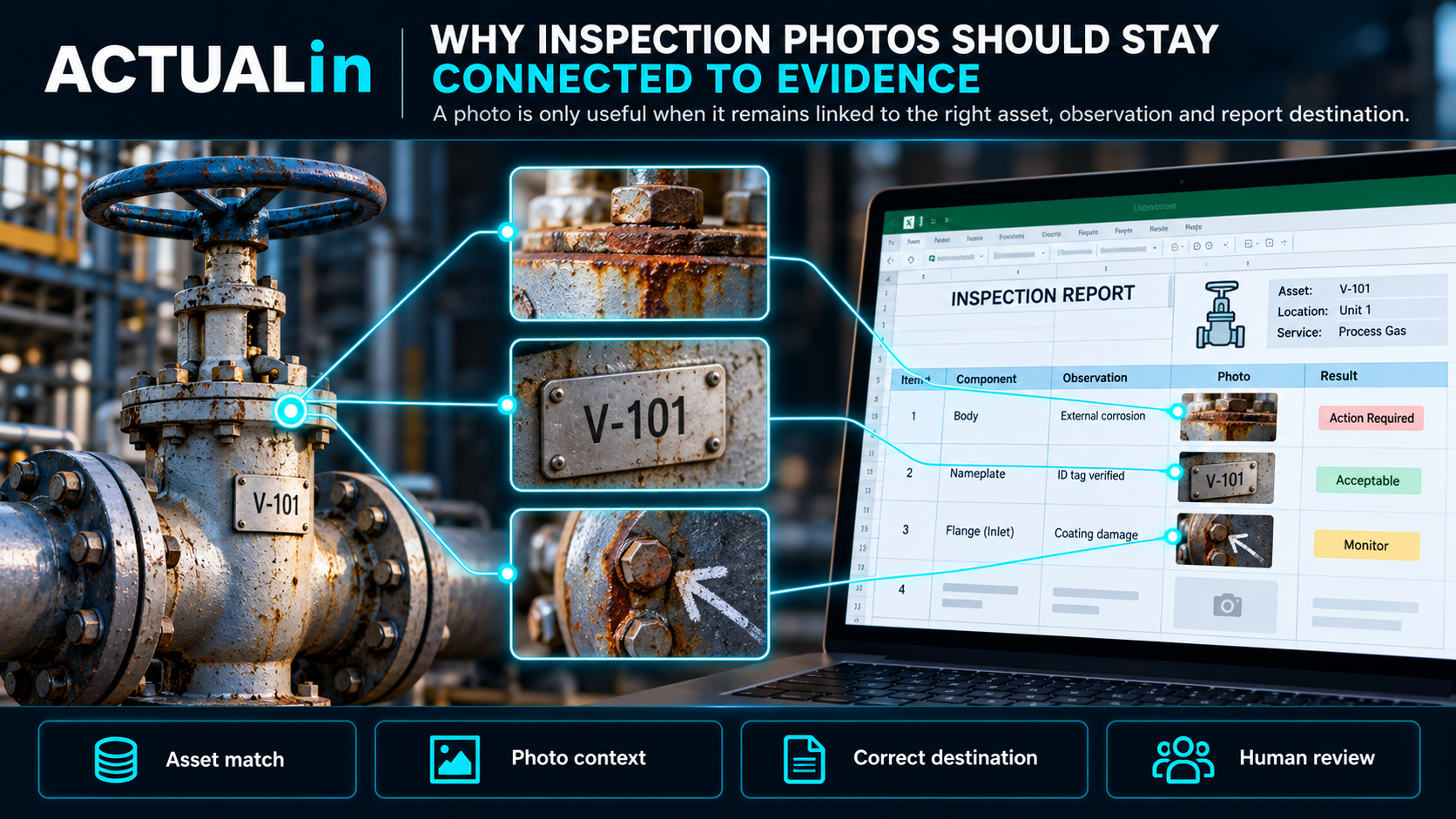
A close-up photograph can clearly show corrosion, coating damage or a surface indication without identifying the equipment where it was taken. It documents an appearance, but it does not automatically establish the inspected asset, its location or the observation it supports.
This is why an inspection photo is more than an image file. Its usefulness depends on a connection to the surrounding field evidence. That relationship has to survive the journey from the inspection site to the customer's report.
A photo with no identifiable subject
Consider an illustrative inspection with two similar pipe flanges. The technician records a surface observation on one flange and takes a close-up photograph. Later, the image is transferred into a folder as IMG_2047.jpg. The filename distinguishes the file, but it does not establish which flange appears in the photograph.
The time it was captured may help narrow the possibilities. A neighboring wide-angle image may provide context. A recorded component identifier may resolve the question entirely. None of those clues should be invented after the fact.
If the two flanges are visually similar and the original record does not identify the photographed component, assigning the photo to either one remains uncertain. This scenario illustrates an evidence problem, not a recorded ACTUALin customer incident.
The chain worth keeping
The goal is to make each relationship reviewable rather than rely on a later recollection of the job.
Original photograph → identified component or location → recorded observation → proposed report entry
The original photograph preserves what was actually captured. It should not be treated as evidence for a different observation simply because the subject looks similar.
Component and location context explain what the image is intended to document. A trustworthy association might come from a recorded identifier or another piece of field evidence, not only the image order.
The observation states why the photo matters. For example, it may describe coating loss or a measured condition at a named inspection point. The image can support that description without replacing the underlying note.
The report entry is the destination where the evidence will be presented. A repeated photo area in an Excel workbook does not, on its own, establish which component belongs there.
The W3C provenance model explains ways to describe how information originates and is related to later outputs. The Library of Congress guidance on still-image formats addresses the preservation of digital image information. Neither source supplies the missing identity of a photographed asset.
Where context disappears
Several ordinary fieldwork steps can break the connection. A group of photographs may be copied to a shared folder separately from the inspection notes. A technician may photograph several components in sequence and later return to one for a retake. A report writer may see a close-up with no wider image or identifier. The files remain intact while the reason for each image becomes harder to establish.
A missing photograph is usually obvious. A convincing image attached to the wrong component can be harder to notice because it appears to belong. That is particularly true when a workbook repeats identical evidence sections for different areas.
Captions help only when they describe supported context. Generating a confident caption such as “corrosion at flange A” does not recover a lost location if the original evidence cannot distinguish flange A from flange B.
What should happen to an unresolved image?
An unresolved photograph should remain available for review with its original file and any reliable supporting context. The reviewer can compare the observation, nearby evidence and component records, or request clarification from the person who captured it.
Association not supported → keep image unresolved → request context → approve only when justified
That is different from discarding the image or placing it into the nearest empty report section. It makes uncertainty visible while avoiding an unsupported evidence relationship.
When an association is confirmed, the image, observation and destination can be handled as a connected reporting unit. A controlled workbook-writing step should then follow the approved destination without making a new interpretive choice.
Preservation starts before report generation
The strongest opportunity to protect photo context is when field evidence is first recorded. Capture the component or inspection area identifier when it is available, retain the original observation and keep any supporting overview or detail images associated with that record.
This does not require every technician to manually rename every image. It does require a defensible path from the file back to its subject and purpose. Sequence and timestamps may be useful supporting clues, but they are not proof by themselves.
The practical test is simple: could another person who was not present at the inspection identify what this photograph supports without guessing? If the answer is no, the relationship needs more evidence or an explicit unresolved status.
Evidence continuity is different from photo placement
This article concerns the identity and meaning of photo evidence. A separate problem is how an approved photograph fits into an existing customer's Excel workbook without disturbing its formulas, layout or other images. That implementation question is examined in the photo-placement workbook test.
The distinction matters. A beautifully formatted report can still attach a correct image to the wrong finding. Preserving the evidence relationship first gives human reviewers something trustworthy to authorize before any image is placed.