AI & HUMAN REVIEW · 9 MIN READ
Why Human Review Still Matters in AI-Assisted Technical Reporting
Human review should not be a ceremonial click after AI finishes a report. It should be the point where proposed changes are checked against source evidence, uncertainty is resolved and responsibility for the final document becomes explicit.
For the underlying technical principles, NIST's AI Risk Management Framework addresses governance and risk management for AI, while W3C's PROV model defines how information can be linked to its sources and transformations. These sources describe the underlying concepts, not ACTUALin performance.
Published September 29, 2026 · ACTUALin Technical Resources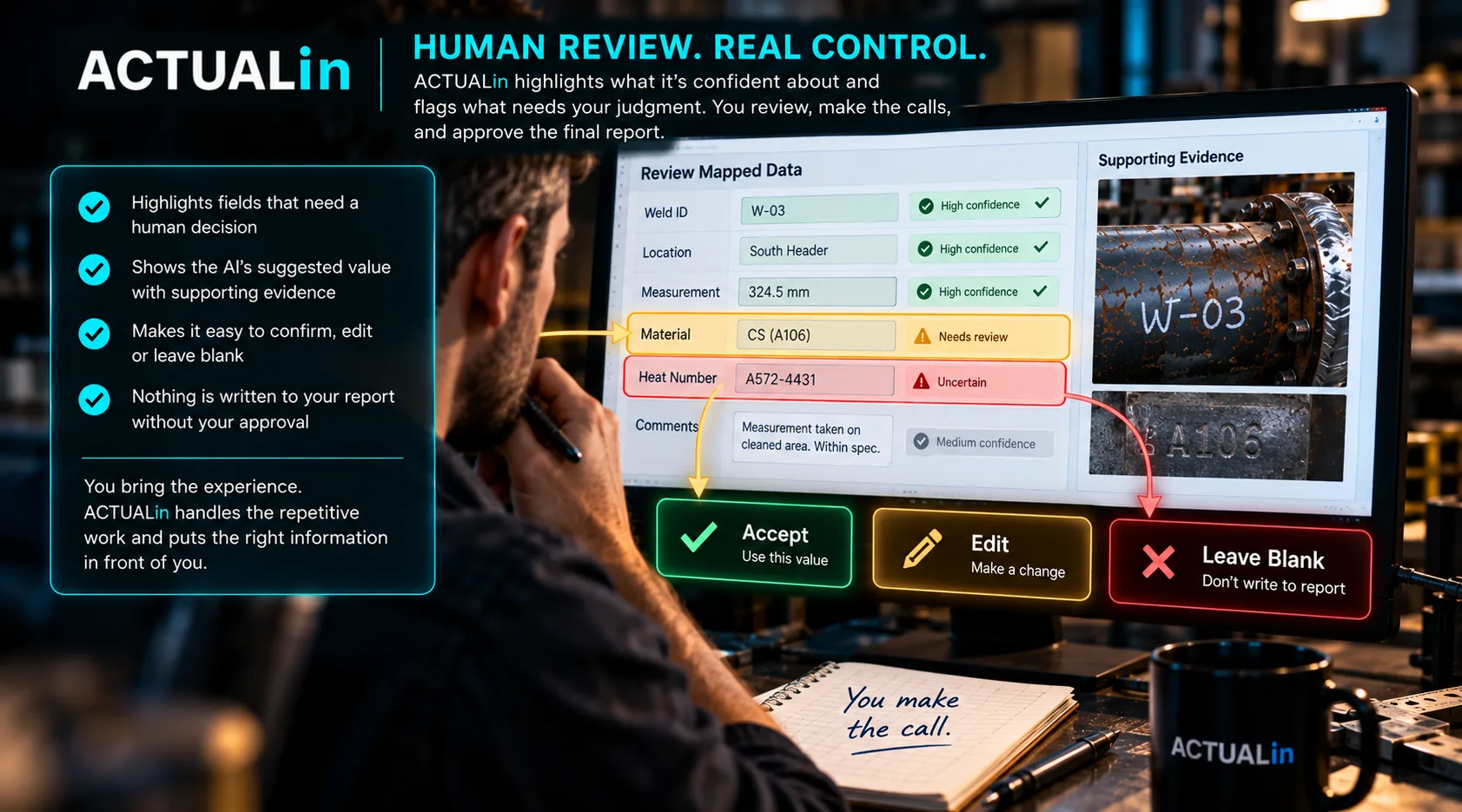
Imagine a reviewer looking at a proposed thickness entry for an inspection report. The number has a source note, the units appear reasonable and the destination field is labeled correctly. The problem is that the workbook contains two components with the same field name. The note does not identify which one was measured.
A system can produce a convincing report by picking one. A meaningful human review does something harder: it identifies exactly which decision remains unsupported and prevents that entry from becoming part of the final document.
This is an illustrative scenario, not a reported ACTUALin customer incident or measured error rate. It illustrates why review must be about evidence, destination and authority, rather than simply checking whether a completed report looks right.
The decision a reviewer actually faces
For that thickness entry, the reviewer needs the original note, any related asset or location identifier, the proposed worksheet and cell, and the reason the system chose that destination. If two sections remain equally plausible, there is no safe approval to give until the missing identity is resolved.
Source note + asset context + proposed destination → approve, reject or leave unresolved
Reviewing the finished spreadsheet alone makes the reviewer reconstruct this chain after the change has already happened. Showing the proposal before writing makes the decision explicit at the point where a mistake can still be blocked.
What the review screen must reveal
The proposed value is only one part of the information. A useful review view should let a person check the following relationships without searching through an entire workbook:
Source: What was recorded in the field, and was it altered or paraphrased?
Subject: Which asset, component, location or inspection area does the evidence identify?
Destination: Which workbook sheet and field would change, and is it safe to modify?
Uncertainty: What is missing, conflicting or merely inferred?
Decision: Can the person reject or hold the proposal without the system silently choosing a different answer?
These are practical design criteria. They should not be interpreted as a claim that every customer workbook and evidence type is already supported by ACTUALin.
Three reasons a plausible entry can still be wrong
Correct number, wrong component. Repeated workbook sections can use identical labels. A recorded measurement can be accurate while its proposed location is not.
Accurate observation, changed meaning. A note with uncertainty or a qualification may turn into a definite conclusion when summarized. The reviewer must compare consequential wording with the source rather than accepting professional-sounding text.
Correct destination, unsafe workbook change. A proposed location may contain an authored formula, merged region, drawing or previous content. Approval of the value is not approval to damage the surrounding report.
The W3C provenance model describes how information can be related to its origins and transformations. The NIST AI Risk Management Framework provides a broader approach to managing AI risk. Neither source validates a particular ACTUALin implementation, but both help explain why a readable result alone is insufficient.
Stopping is a valid review outcome
An unresolved field is visible work. An unsupported value entered into the wrong section may be much harder to notice. When the source cannot establish an association, leaving the destination unchanged is a legitimate result, not an incomplete attempt to impress the reviewer.
Ambiguous association → hold the write → obtain evidence or human resolution
Different fields also require different decisions. Transferring a confirmed job identifier to a clearly identified header is not equivalent to approving a procedure-dependent acceptance conclusion. Technical judgment and final authorization must remain with the responsible person and the organization's established process.
Review should control the write, not repeat it
A reviewer should not need to type the data again to preserve control. Once the evidence relationship and destination are confirmed, a constrained writer can apply the approved change without creating another interpretation step.
The boundary matters: the system proposes a relationship, a person decides whether the evidence supports it, and the workbook writer executes only permitted changes. Post-generation inspection still has value, especially for formatting and formula preservation, but it should not be the first opportunity to discover an unsupported mapping.
To evaluate such a workflow, give it repeated field labels, a source without an asset identifier, and a workbook containing protected or authored content. These are suggested tests, not verified results. The question is whether it shows the reviewer what is unresolved and protects the output when approval cannot be given.
The point of keeping a person involved
The aim is not to maximize the number of clicks a reviewer performs. It is to put human attention where the consequences of a wrong association, technical interpretation or authorization matter.
Good automation can reduce searching, retyping and repetitive assembly while preserving the person's ability to say: this evidence does not yet support this report entry. That is a real review decision, not a ceremonial approval after the report is already complete.