 ACTUALin
AI & HUMAN REVIEW · 9 MIN READ
Where AI Fits and Doesn't Fit in Inspection Reporting
AI can be valuable when inspection reporting requires understanding messy evidence and workbook context. That does not mean it should silently decide technical conclusions or become the final authority over the report.
For the underlying technical principles, NIST's AI Risk Management Framework addresses governance and risk management for AI, while W3C's PROV model defines how information can be linked to its sources and transformations. These sources describe the underlying concepts, not ACTUALin performance.
Published September 28, 2026 · ACTUALin Technical Resources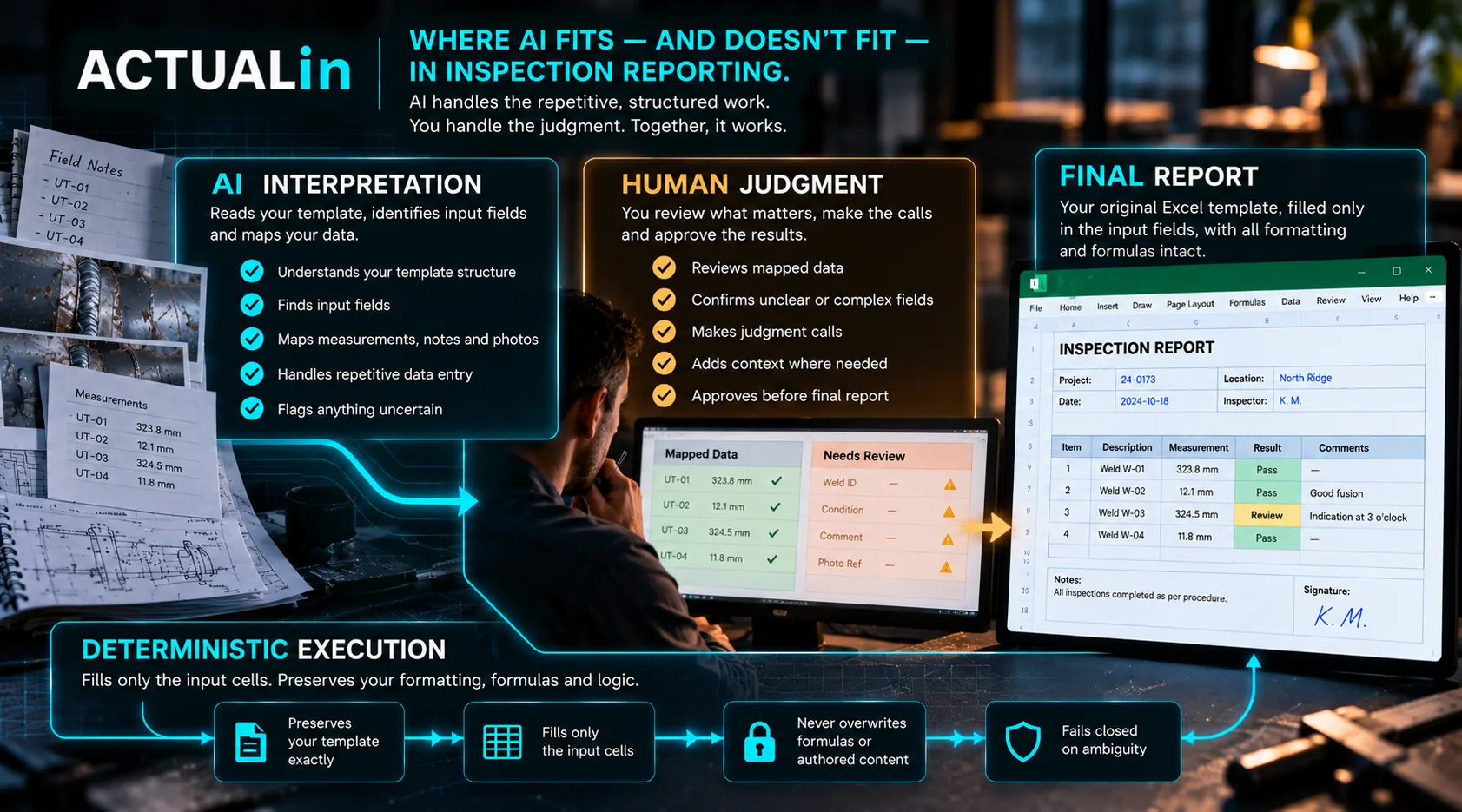
The useful question is not whether AI can fill an inspection report. It is whether a particular part of that work benefits from interpretation, and whether the software can stop before an interpretation becomes an unsupported technical decision.
Consider two sources that do not speak the same language: a technician's field note and a customer's Excel workbook. The note may describe a location informally. The workbook may organize it by asset, component and inspection area. Matching them takes context. Writing an approved measurement into a confirmed cell should not take creative interpretation at all.
Where AI earns a place
Field notes are often incomplete sentences, abbreviations and references that make sense beside other job evidence. Workbook labels can also be inconsistent between customers. AI can help identify candidate relationships between those descriptions and the workbook's existing structure.
That creates a useful proposal, not a fact about where a measurement belongs. The source measurement, unit and recorded qualifications should stay intact. The proposal needs to say which evidence supports it and where it would be written.
Original evidence + workbook context → candidate destination, with evidence for review
The difference matters most when several plausible answers exist. If the note says only “north support” and the workbook contains multiple north-side sections, a polished answer does not make the missing asset identifier appear.
The ambiguous-field test
Imagine a note containing one thickness reading without an asset identifier. Two asset sheets each have a field called “Thickness.” The number may be valid, but neither destination is established. This is an illustrative scenario, not an ACTUALin benchmark or a customer case.
One approach is to choose the closest text match and fill a cell. Another is to expose both possible destinations and ask for the missing context. The second may leave the report visibly incomplete, but it preserves an important distinction: a recorded measurement is not the same as a verified report association.
That is the failure mode worth testing. Does the proposed mapping remain unresolved when the evidence does not support it? Can the reviewer see what was considered? Is the workbook protected from the unapproved write?
A boundary between interpretation and execution
AI can help interpret shorthand or the surrounding meaning of a field. A workbook writer has a different responsibility: write only approved information to approved destinations while preserving formulas, merged areas, existing content and the customer's layout.
Combining those roles makes a wrong guess harder to detect. If interpretation and writing happen together, a finished-looking workbook can conceal which source was used, why a location was selected and what was changed.
Interpretation proposes → reviewer decides → constrained workbook writer executes
These are design boundaries, not a claim that all ACTUALin workbook scenarios have already passed testing. Customer templates with repeated fields, protected content, drawing objects and uncertain associations still require explicit validation.
Three decisions AI should not make silently
Technical acceptance. A measurement is evidence. A pass or fail conclusion may depend on procedure, method, criteria and qualified judgment. Locating an input field is not authority to decide the final technical outcome.
Missing evidence. If a component, unit or source is uncertain, the system should surface that uncertainty rather than fabricate a plausible detail. An unresolved field is better than an unsupported value entered as fact.
Final authorization. A generated workbook is not the same as an approved technical record. Approval should remain a deliberate responsibility with clear visibility into proposed changes and withheld items.
How to evaluate a reporting assistant
Do not test only the easy example where every source value matches one obvious cell. Include two repeated labels, a blank that could be a formula, a destination already containing customer-authored information, and a note missing the identifier required to choose a section. Those are proposed test scenarios, not reported performance outcomes.
A useful review asks whether source text remains intact, whether uncertain mappings are withheld, whether the writer protects untouched workbook features, and whether the reviewer can reject a proposal without repairing the workbook afterward.
There is a broader reason to document these decisions. The NIST AI Risk Management Framework covers the governance and evaluation of AI risks, while the W3C provenance model describes relationships between information and its sources. Neither document evaluates ACTUALin, but both inform the distinction between producing an answer and producing an explainable record.
Use AI for variation, not invisible authority
Inspection reporting needs flexibility where technicians and customer reports use different descriptions. It needs predictability when values are actually written, and human judgment where the evidence is ambiguous or the decision is consequential.
That is a narrower role for AI than “finish the report automatically.” It is also one that can be tested against real workbooks, including the cases where the correct outcome is to stop.