TECHNICAL REPORTING · 10 MIN READ
The Report Isn't the Problem. The Duplicate Entry Is.
Many technical teams already have a report that works. The expensive part is the second pass through the same information: reconstruct the field evidence, find its destination, enter it again, organize the photos and verify the transfer.
For the underlying technical principles, NIST's metrological traceability guidance explains documented measurement relationships, while W3C's PROV model defines how information can be linked to its sources and transformations. These sources describe the underlying concepts, not ACTUALin performance.
Published October 3, 2026 · ACTUALin Technical Resources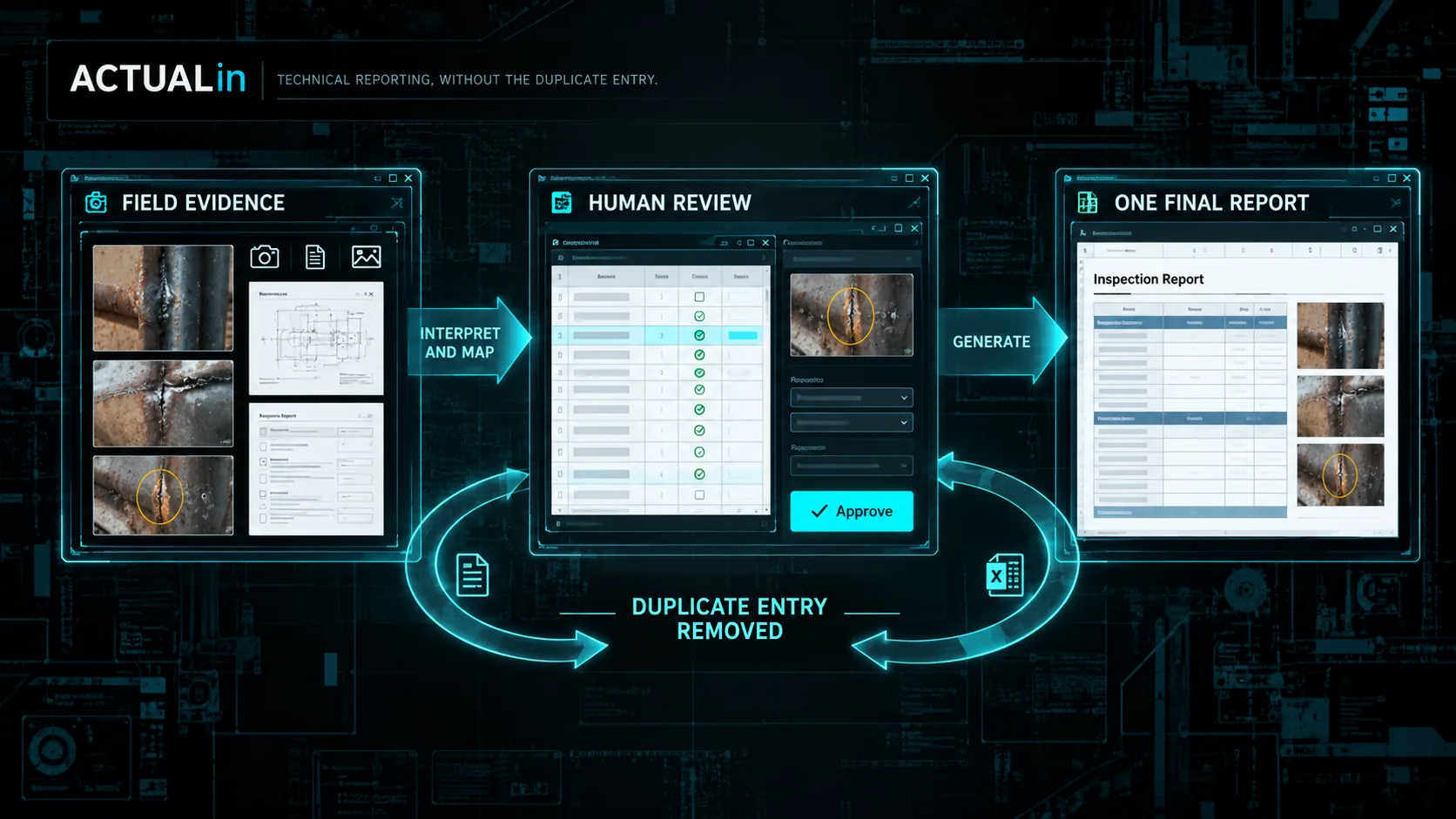
Before replacing an inspection report, check whether the document is actually causing the delay. If a customer already accepts the Excel workbook and its formulas still serve the job, the bigger expense may be entering information that was recorded during the inspection a second time.
That second pass is rarely just typing. Someone has to locate the field record, identify the component, find the right report section, copy the information and check that it landed in the correct place.
Follow one measurement through two recording steps
Consider an illustrative inspection where a technician records a thickness reading for Component B, with its location and units. Hours later, the report writer opens the customer's workbook, finds the matching component section and enters the same reading again.
The second entry did not create new evidence. It transferred information that already existed. If the report has repeated component sections, that transfer also introduces a possible association error: a valid measurement can be entered against the wrong component.
Field measurement recorded → source located again → component identified again → value entered in customer report
This is a hypothetical workflow illustration, not a measured customer case or verified ACTUALin productivity claim.
Calculate what the handoff costs
Count only the work that takes place after the source evidence is already available: finding notes, re-entering values, matching photographs, navigating report sections and correcting transfer mistakes. Do not count the technical inspection itself as avoidable data entry.
For a simple baseline, multiply the number of reports completed each month by the average minutes per report spent on this duplicate handling, then divide by 60. For example, 40 reports at 25 minutes each equals about 16.7 hours per month. Those numbers are illustrative, not ACTUALin customer data.
Reports per month × duplicate-handling minutes per report ÷ 60 = hours per month
Track corrections separately where possible. A fast first draft that needs substantial rework may save less time than its generation speed suggests.
Replacing the workbook can add another handoff
If the customer's accepted Excel document is still required, adding a new field application may not remove the last reporting step. Teams might capture data in the app, review it elsewhere and then still transfer it into Excel.
That approach may offer other benefits, but the duplicate-entry problem persists unless the new process actually removes or shortens the transfer. The replacement decision should therefore depend on the organization's wider needs, not the age of the spreadsheet alone.
The W3C provenance primer describes relationships between information and its origins. The Microsoft Open XML spreadsheet documentation explains the structure of Excel workbooks. These references help frame evidence transfer and document preservation, but do not demonstrate time savings for any product.
Remove repeat handling without removing review
A useful assisted workflow connects existing evidence to proposed destinations in the customer's workbook. The reviewer sees the original reading, its component identity and the intended field before approving a write. Unsupported associations remain unresolved, rather than being forced into the next available cell.
Approved changes should be limited to intended input locations. Existing formulas, merged regions, customer-authored content, photographs and print settings must be protected when the original workbook is the required deliverable.
Recorded evidence + customer workbook → reviewed proposed transfer → authorized output
This is a workflow design principle. Actual compatibility must be tested against the customer's workbook and evidence, including ambiguous cases.
Decide whether to fix the report or the handoff
If a workbook prevents necessary collaboration, data management or technical controls, replacement may be justified. If the workbook is already an accepted deliverable and the main frustration is moving recorded information into it, begin by improving that handoff.
For a comparison of the two approaches, see when replacing Excel inspection reporting makes sense. For measuring end-to-end gains, see how to evaluate reporting time without giving up control.
The goal is not to keep every spreadsheet forever. It is to avoid rebuilding a document when the repeated handling of evidence is what actually needs to change.