 ACTUALin
AI & TECHNICAL REPORTING · 9 MIN READ
Why Leaving a Report Field Blank Can Be Better Than an AI Guess
A complete-looking technical report is not automatically a better report. When the source evidence does not support a unique answer or destination, leaving the item unresolved can preserve more information than filling the gap with a plausible guess.
NIST AI Risk Management Framework addresses managing AI-related risks; the W3C provenance model explains relationships between information and its origins.
Published October 2, 2026 · ACTUALin Technical Resources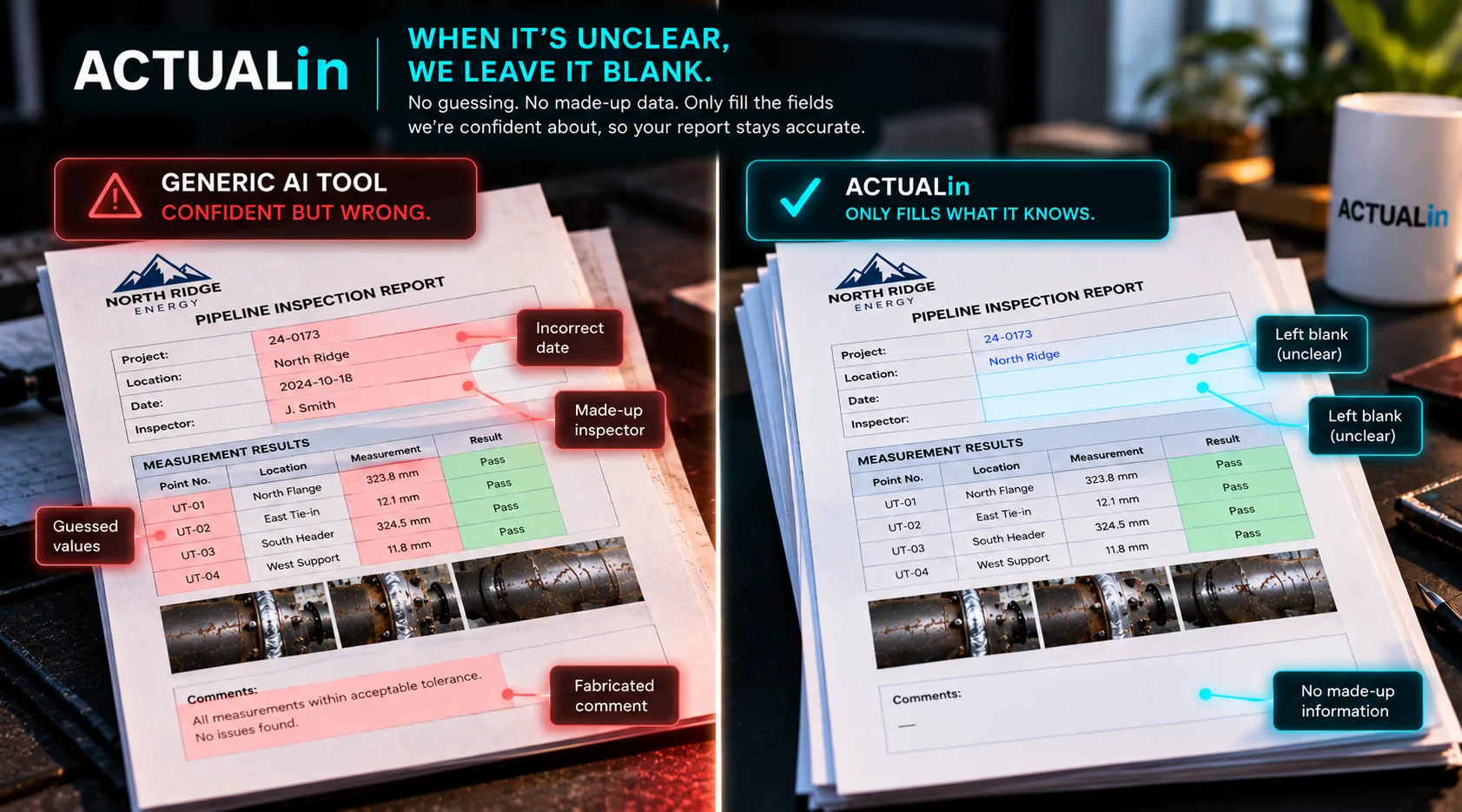
A report field that remains unresolved can be safer than a field populated with an unsupported answer. The difference is not cosmetic. An unresolved item alerts a reviewer that the evidence or destination is incomplete. A plausible entry in the wrong place may escape notice because the report looks finished.
To see the distinction, consider a hypothetical thickness reading of 4.2 mm recorded without a component identifier. The customer's workbook contains two components, each with a thickness field. The measurement may be perfectly valid, but the evidence does not establish which component it belongs to.
What exactly is missing?
In this example, neither the numerical value nor the field type is the problem. The missing information is the relationship between the source reading and the specific workbook section. Selecting the first matching field, the nearest empty cell or the most likely component would add a fact that was not recorded.
Known measurement + two plausible destinations → unresolved association, not an approved write
This is an illustrative example, not a reported customer incident or an ACTUALin benchmark result. It demonstrates that confidence in recognizing a measurement is different from evidence supporting its destination.
Three different reasons a field may stay blank
The value is missing. There is no recorded measurement or observation to transfer. The software should not infer a technical result from the surrounding cells.
The association is missing. The value exists, but the asset, component or inspection area is uncertain. A reviewer needs to establish which report field, if any, is supported.
The proposed write is unsafe. The intended coordinate may contain a formula, existing authored content or a covered merged cell. Even a correct source-to-destination association does not authorize damaging the original workbook.
These conditions need distinct explanations. A generic “low confidence” indicator does not tell the reviewer whether to collect evidence, identify a component or address a workbook constraint.
A refusal should be actionable
When a write is withheld, a useful review item identifies the source evidence, the competing or blocked destinations and the reason for stopping. It should preserve the original recorded information and let an accountable person resolve the specific uncertainty.
Unresolved item → visible reason → reviewer decision → approved change or no write
This is consistent with the risk-management emphasis of the NIST AI Risk Management Framework. The W3C provenance model also describes relationships between information and its origins. Neither source validates ACTUALin's performance. They provide useful context for why unsupported associations should remain identifiable.
How to test the stopping behavior
Use a copy of a customer-style workbook with repeated fields and an intentionally incomplete source note. Verify that the uncertain entry does not reach either candidate destination. Then supply the missing component identifier and check whether a clear proposal can be reviewed without changing unrelated cells.
Test other refusal conditions separately: an occupied destination, a formula field and a merged child coordinate. A system should not respond to a blocked coordinate by guessing a neighboring blank. These are proposed acceptance tests, not claims that all such scenarios have passed in every ACTUALin workspace.
Counting populated fields alone is insufficient. A report with fewer filled fields may be more trustworthy when the withheld entries are the ones the evidence could not support. Test whether the output tells the reviewer what remains unresolved, not merely whether it appears complete.
The right outcome is sometimes no change
Automation can remove transcription work while preserving a clear boundary around technical judgment. It can recognize a likely field, propose a location and help organize evidence without pretending to know what was never recorded.
For a related look at why repeated destination labels create this uncertainty, see the repeated-fields example. The point here is narrower: when a value or destination is unsupported, leave the authoritative workbook unchanged until someone can justify the entry.